Services
Save 64% in tax using relevant life insurance
Discover how relevant life insurance can save you tens of thousands of pounds in corporation and income tax while providing essential life insurance for your family.

64%
The saving you can make in tax when using relevant life insurance.
£39,756
Average saving for other directors we deal with.
HMRC
Approved by HMRC as a qualifying business expense.
About us
What is Relevant Life Insurance?
Relevant life insurance is essential life insurance for you and your family, but it is paid for by your business as a qualifying business expense. It provides a tax-free payment for your family in the event of your death, but also provides you with tax relief while you're alive, as it's paid for by your business instead of from tax-paid income like a personal policy.
On average, as a higher-rate taxpayer, it is 64% more tax-efficient than a personal life insurance policy and can save tens of thousands in tax over the full term.

OUR TRUSTED INSURERS






Benefits overview
Key benefits of Relevant Life Insurance
Relevant life is on average 64% cheaper than personal life insurance when you consider the tax saving.

The Quick Version
- What it is: Life insurance for your family, paid by your limited company, approved by HMRC since 2006
- Who it's for: Limited company directors and employees in the UK
- How much you save: Up to 64% compared to paying personally
- How to get it: One call - we search every UK insurer and present your options
Relevant Life Insurance
If you are a company director or shareholder and pay for your life insurance personally, you're probably paying thousands in tax you don't need to. Relevant life insurance is designed for company owners like you, and not using it is leaving tax savings on the table.
"On average, our other clients save £39,756 in tax over the life of a policy by using relevant life insurance"
The Tax-Efficient Alternative
Relevant life insurance is a policy arranged through your limited company, which means the business pays the premiums rather than you paying them from your personal income. HMRC treats those premiums as an allowable business expense, so your company receives:
- Up to 25% corporation tax relief (subject to company marginal rate)
- Income tax savings of up to 45% as no personal income is needed (your highest marginal rate)
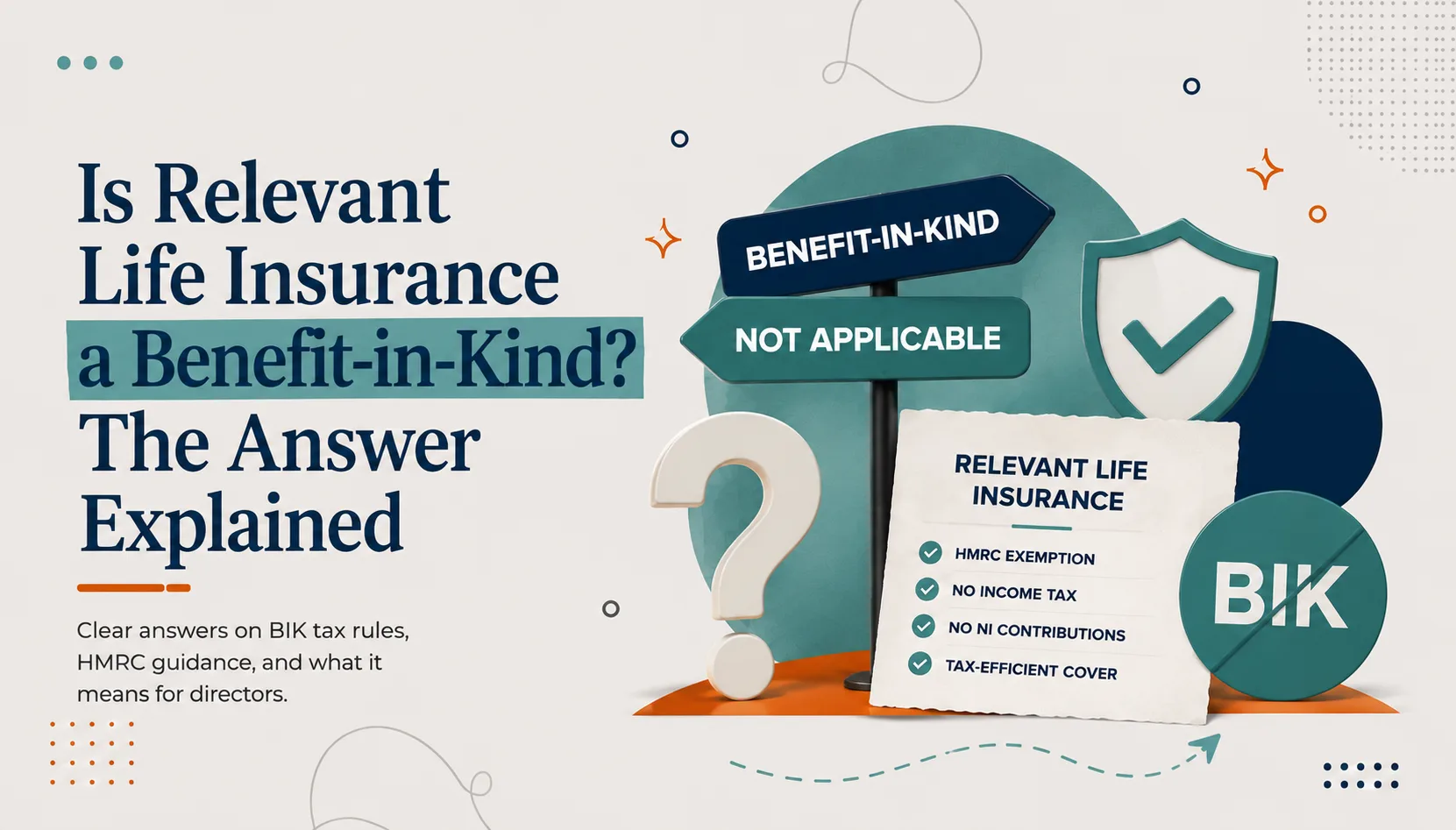
- Zero benefit-in-kind
- Tax-free payment if ever used
That combination of corporation tax relief going in and no tax charge coming out is what makes relevant life one of the most genuinely efficient planning tools available to a UK company director.
How Much Could You Save?
Below is a table showing the true cost of a personal policy when you factor in the tax the company and you personally would need to pay to fund the premiums from net income. Compared with relevant life insurance paid by the business, the savings are considerable.
The table shows how the same £100 a month premium would be treated when you consider tax. In the personal policy column, to receive a payment of £100 to pay a personal premium, your business would have started off with the cost of £207.52. Corporation tax at 25% would have been deducted, then dividend tax at the higher rate, resulting in a true cost to the business of £207.52.
Paid as a relevant life policy, the business paid £100 and claimed corporation tax relief on this expense, reducing the true cost to just £75, subject to the company's tax rate.
The result is a huge tax saving over the life of the policy.
Is the Cover the Same as a Personal Policy?
Remember that relevant life insurance is a different type of policy from personal life insurance. It has to be, because the structure is what qualifies it for corporation tax relief. But the benefit your family receives is identical. If you die during the term, a tax-free lump sum is paid out, just as it would be under a personal policy. And it's underwritten by the same insurers you'd already recognise, Legal & General, Aviva, Zurich, LV and others. Different structure, same outcome, significantly lower cost.
What Happens to the Payout?
The cover works exactly as you'd expect. If you die during the term, a tax-free lump sum is paid to your family through a discretionary trust. You can also cover a spouse who works in or holds shares in the business, which makes this a particularly useful tool for family-run companies.
If you're currently paying for your life cover personally, it's worth taking just 60 seconds to see how much you can save with our savings calculator.
How Does Relevant Life Insurance Work?
The mechanics of relevant life insurance are simpler than most people expect, and understanding them is what makes the tax efficiency make sense.
The Company Pays the Premiums
Your limited company takes out the policy and pays the premiums directly. HMRC treats those premiums as an allowable business expense, the same way the company would treat any other legitimate business cost. That means the company gets corporation tax relief on every payment, and because the business pays the premiums rather than you paying from salary or dividends, you don't pay income tax on them either.
No Employer's National Insurance
On the employer's side, there's no National Insurance liability to worry about. Unlike a salary increase or a cash bonus, relevant life premiums don't trigger an employer's NI charge. The business pays the premium, claims the tax relief, and that's the end of its liability.
Smooth process, easy to deal with and most importantly they saved me a lot of tax by switching my policy to one that could be paid for by the business.

Who Qualifies for Relevant Life Insurance?
If you're a director or employee of a UK limited company, then you almost certainly qualify for relevant life insurance. But it's worth understanding the full picture, because a few specifics can catch people out.
Directors of Limited Companies
This is the most common use case, and the one where the tax saving is most significant. If you're a director drawing a salary through a limited company, or sometimes even no income, then your company can arrange a relevant life policy on your behalf. You don't need to be a large business. A single-director limited company qualifies in exactly the same way as a company with fifty employees.
Employees
Relevant life isn't just for directors. Any employee of a limited company can be covered under a relevant life policy, which makes it a useful tool for businesses that want to offer meaningful benefits to key staff without the cost and administration of a full group life scheme.
Are There Any Other Conditions?
The insured person must be an employee or director of the company taking out the policy. The policy must also be used solely to provide a death-in-service benefit, and the sum assured must not be excessive relative to the individual's role and remuneration. In practice, insurers and advisers apply these rules routinely.
Three Tax Advantages Working Together
Corporation tax relief reduces the business's costs. No BIK means you don't pay income tax on the benefit. No employer's NI means the business doesn't pay a secondary charge either. Together, they make relevant life one of the most efficient ways to fund personal protection within the UK tax framework.
How Much Does Relevant Life Insurance Cost?
This is usually the first question people ask about relevant life insurance, and the honest answer is that the premium depends on you: your age, your health, the level of cover you need, and the term you want to cover.
Like-for-like, it has the same premium as a personal policy, so no additional premiums are charged just because it is relevant life.
Below is a table that shows age related premiums for £500,000 and £1,000,000 cover.
Example Life Insurance Premiums
What Affects the Premium?
Your age is the biggest factor in life insurance premiums. The younger you are when you take out the policy, the lower the premium, and that premium is typically fixed for the life of the policy, so arranging cover sooner locks in at a lower rate for the full term. Your health and lifestyle also play a role, and underwriting approaches vary considerably between providers.
What Does It Cost in Practice?
For a director in their late thirties or early forties, a non-smoker in good health, looking for £500,000 over a 20-year term, the only way to know your specific number is to get a quote. We compare every insurer in the market, including Legal & General, Aviva, Zurich, LV and others.
Relevant Life Insurance vs Personal Life Insurance
If you're currently paying for life insurance personally, this comparison matters most. The cover itself is the same either way. What differs is what that cover costs you in real terms
A personal life insurance policy is paid for from your income after tax. By the time money reaches your personal bank account as a director, it's already been through corporation tax, and then income tax and National Insurance on your salary or dividend. Paying a personal premium from that money means HMRC has already taken a significant cut before the insurer sees a penny.
How to Set Up Relevant Life Insurance
Setting up a relevant life policy is considerably simpler than most directors expect. Your job is to decide on the level of cover you need and answer a few straightforward questions. Everything else is taken care of.
1. Get a Whole-of-Market Quote
At Executive Life we search every insurer in the market, including Legal & General, Aviva, Zurich, LV and others, and come back to you with a clear comparison. No data sharing, no passing your details to a panel of brokers, just our team providing the information you need.
2. Choose Your Cover Level and Term
Most directors base this on their outstanding debts, their income, and the level of financial security they want to provide. There's no single right answer, and it's worth talking it through rather than picking a number without context.
3. Complete the Application
You'll answer questions about your health, lifestyle, and medical history. For most directors in good health, this is straightforward. Where insurers need more information, then your adviser manages that process on your behalf.
4. Set Up the Discretionary Trust
Your adviser prepares the trust documentation as part of the application process. You sign it, and the policy is written into trust from day one.
The trust structure, who owns the policy, and how the premiums are classified must align for HMRC to accept the tax treatment. If this is wrong, for example if the policy ends up owned personally rather than by the company, or if the trust isn't in place before the first premium is paid, HMRC can treat the premiums as a Benefit in Kind, undoing the tax saving the whole arrangement was built on. That is why an adviser prepares the documentation, rather than you having to put it together yourself.
5. The Company Starts Paying Premiums
Once the policy and trust are in place, the company pays the premiums directly as an allowable business expense. Your accountant treats them in exactly the same way as any other qualifying business expense.
How Long Does It Take?
In straightforward cases, cover can go live as soon as you complete the application. Where additional medical information is required, many insurers offer temporary cover in the interim so you're not left without protection while your application works its way through
One Thing Worth Doing Now
If you're currently paying for personal life insurance, it's worth checking whether you can replace that policy with a relevant life arrangement and what you'd save. A quick quote costs nothing and takes 60 seconds to request.
Request your quotation and tax saving calculation now
No obligation conversation with one of our experts
Tax saving calculator
Adjust the values below to see your potential tax savings.
Your Policy Details
Your information is secure and will not be stored
Your Results
Based on your inputs
Estimated annual saving
Monthly saving
Total Saving over term
A saving of
compared to personal life policy
See how much your business could save
Get a personalised quote and speak to our team
Trusted by business owners like you
Our customers
Trusted by business owners like you



Why choose us
More tax efficient life insurance
This comparison shows the difference between paying for a personal life policy yourself versus a Relevant Life Policy paid by your business. Both policies have the same premium of £100.00, but a Relevant Life Policy with Executive Life can dramatically reduce a pre-tax cost.
total savings over 25 years
Figures are based on a 25-year policy paid by a higher-rate tax payer. Figures will vary subject to the tax status of the life assured.


lower true cost
saving per month
annual saving
Who Can Get Relevant Life Insurance?
Yes and for most directors, arranging it this way is significantly more tax-efficient than paying personally. A relevant life policy is specifically designed for this purpose. The company pays the premiums as an allowable business expense, qualifying for corporation tax relief, and neither you nor the business picks up a Benefit in Kind or employer's National Insurance charge on top.
Yes. HMRC treats relevant life premiums as an allowable business expense, which means that the company deducts them from its taxable profit before calculating its corporation tax bill. The premiums don't attract a Benefit in Kind charge for the director, and there's no employer's National Insurance liability for the business.
Both provide life cover through a business and both qualify for corporation tax relief, but they work very differently in practice. Group life is a single scheme covering multiple employees under standardised terms, typically requiring a minimum number of members. Relevant life insurance is an individual policy with no minimum membership requirement, fully tailored cover, and an individual discretionary trust. For directors and small businesses, relevant life is almost always the better fit.
Yes, relevant life insurance policies are transferable. The policy can be transferred to a new limited company you set up or join, or converted to a personal policy without further underwriting if that's more appropriate. Many insurers include conversion options that preserve the original underwriting terms.
Yes, and this is an essential part of the arrangement, rather than an optional extra. The policy is written into a discretionary trust from the outset, which keeps the payout outside your estate for inheritance tax purposes, ensures the lump sum reaches your beneficiaries without going through probate, and keeps the benefit free of income tax for the people who receive it.
No. Relevant life insurance must be arranged by a limited company. It's the company that pays the premiums and claims the corporation tax relief, and that structure isn't available to sole traders or standard partnerships. If you've been considering incorporating for other reasons, the ability to access relevant life is a worthwhile addition to that conversation.
Insurers typically provide a sum assured of 15 to 30 times the insured person's total remuneration, subject to age, including salary, dividends, and benefits. For most directors, this means they can achieve a very significant level of cover.
Yes, provided your spouse is an employee or director of the company or holds shares in the business. A relevant life policy is arranged on an individual basis, so your spouse would have their own separate policy. For husband-and-wife companies, this means both directors can access the same tax-efficient structure, effectively doubling the tax saving across the household.
Get started
Ready To Get Started?
If you are considering whether relevant life insurance is right for you and your business, or the tax savings you can make, contact us or book a call today.
We can provide a full quotation in as little as 60 seconds and calculate your potential savings for you to consider
Full market comparison | We don't share your data

Our insights
Read our collection of insights and blogs to find out what other business owners and the industry is doing.