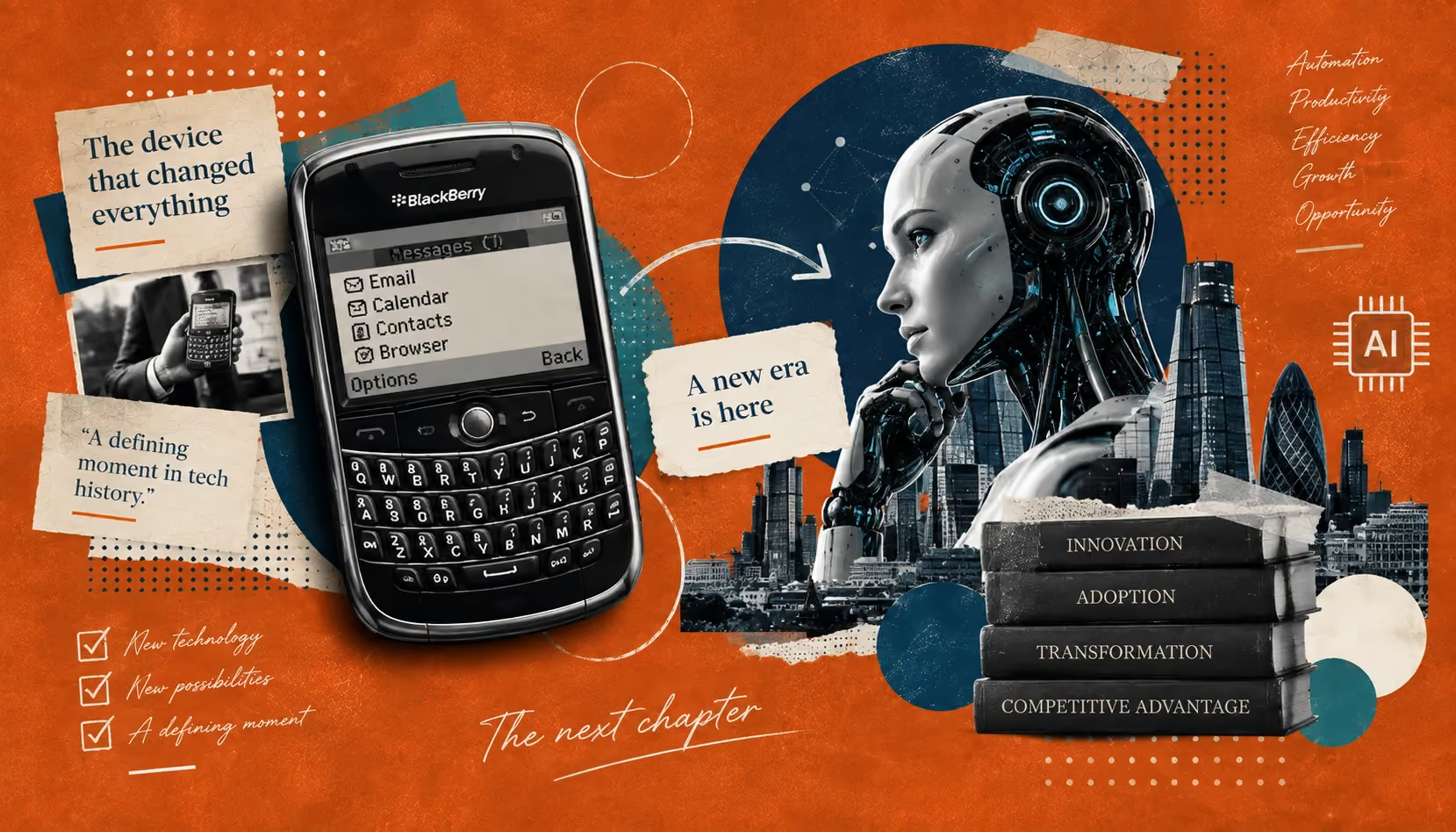
The BlackBerry Moment for AI: Why the Revolution Hasn’t Actually Started Yet


No pressure, no jargon. A short call to work out whether this cover fits your business.
Every transformative technology follows the same quiet pattern before it becomes impossible to ignore. It starts complicated, expensive, and confined to businesses. Then someone simplifies it, hands it to ordinary people, and the market flips overnight.
If you’re a business owner, recognising this pattern matters because AI is about to go through exactly this shift, and most business owners are still thinking about it as a tool rather than the next electricity.
The BlackBerry Blueprint
Through the mid-2000s, BlackBerry wasn’t a consumer product; it was IT infrastructure. Devices were issued by employers and built around one main feature: taking your email out of the office and putting it in your pocket. Before BlackBerry, email meant sitting at a desk in front of a computer.
BlackBerry was the first device that made email genuinely portable. You could read and reply to messages on a train, in a taxi, between meetings, anywhere. That portability, not any particular security credential, was the reason businesses adopted it so completely. At its peak around 2009–2011, BlackBerry commanded roughly a fifth of the global smartphone market, almost entirely through enterprise deployment.
Then Apple launched the iPhone in 2007. Not as a business tool, but as a consumer device people simply wanted. BlackBerry’s interface was built by and for IT departments, with a physical keyboard, dense menus, a device that felt like office equipment – even in your pocket. The iPhone stripped almost all of that away: one button, a touchscreen, an interface anyone could pick up without training.
It wasn’t more capable in every respect; it was simpler, and simplicity is what let it travel from tech enthusiasts to literally everyone. Within a few years, BlackBerry’s market share had collapsed to near-irrelevance.
The lesson: the technology didn’t fail. It was outcompeted the moment someone took the same category of tool and made it radically simpler to pick up and use, rather than more powerful for professionals.
Why Siri and Gemini Might Be AI’s iPhone Moment
AI has followed the “BlackBerry phase” of this pattern closely. Tools like ChatGPT, Claude, and Copilot have spent the last few years being adopted primarily by power users, early-adopter businesses, and specific professional workflows. They are genuinely useful, but still require someone to open an app, write a prompt, and know what they’re doing.
Apple’s partnership with Google’s Gemini to power a rebuilt Siri changes the shape of that story. This matters for three reasons that go beyond “Siri gets smarter”:
It’s Apple’s first major external AI partnership. Apple has historically built or bought its way into new categories, rather than partnering. Handing a core piece of the iPhone experience to another company’s model is a signal that Apple sees this as too important, and too fast-moving, to solve entirely alone and in-house.
It moves AI from “an app you open” to “a layer the device already has.” The described capabilities: booking appointments, searching across your emails and messages, giving directions, answering questions, acting across apps rather than inside one – describe something categorically different from a chatbot window. It’s an agent that sits underneath everything you already do on your phone, without you needing to seek it out.
It removes the single biggest barrier to mass adoption: effort. BlackBerry to iPhone wasn’t a leap in raw capability so much as a leap in accessibility. The same is true here. Most people will never deliberately “go and use AI.” They’ll simply notice that their phone now books the appointment, finds the email, and answers the question without them opening anything new or learning any new behaviour at all.
The Bigger Revolution: Search and Influence Itself
The Siri-Gemini shift isn’t just a device story. It’s the leading edge of a much larger change in who, or what, makes recommendations for us.
For twenty-five years, “finding out about something” has meant searching Google, then choosing between the results, reviews, and adverts that platform decided to show you. Buying decisions have been shaped by whoever won the search results page, or whoever’s post showed up in your social feed at the right moment. That’s been the business model underneath Google and every major social platform: sit between the person and the decision, and monetise the moment of influence.
A personal AI agent breaks that model. If your phone already knows your preferences, your past purchases, your calendar, your budget, and your history, then it doesn’t need to send you to a search results page to work out what restaurant, product, or service is right for you. It can just tell you, or book it, directly. The recommendation and the decision start happening inside the agent, not on a platform designed to hold your attention long enough to sell advertising around it.
That’s a genuinely uncomfortable idea for any business that has spent the last decade optimising for Google rankings or social reach, because it suggests those channels may matter less over time, not more. The businesses that show up in an agent’s recommendation won’t necessarily be the ones who won the SEO game; they’ll be the ones with the strongest reputation signals, reviews, and structured data an AI system can actually trust and act on. It’s a different game, with different winners, and it’s starting now rather than in some distant future.
What This Means If You Run a Business
If your team, your customers, or your industry currently think of AI as “a tool some people use,” the BlackBerry precedent suggests that’s about to become an outdated view very quickly. Once a capability is sitting invisibly inside the device that almost everyone already carries in their pocket, the adoption curve stops being gradual. BlackBerry wasn’t replaced by a better version of itself. It was replaced by something simpler that people preferred to use. AI is on the same trajectory, and the businesses that get found, trusted, and recommended by these agents will look very different from the ones that currently dominate a Google search results page.
The uncomfortable takeaway for business owners is this: the last few years of AI adoption – the chatbots, the pilots, the early experiments – weren’t the revolution. They were the BlackBerry phase. The consumer moment, the one that actually changes behaviour at scale, is only just arriving. Businesses that treat what’s happening now as “AI, but more” rather than “the actual starting gun” risk being the ones still handing out BlackBerries in 2011.
Written by
Alex Ogden DipFA | Director | Executive Life
Alex Ogden DipFA holds the Level 4 Diploma for Financial Advisers (DipFA) awarded by the Walbrook Institute London, formerly known as the London Institute of Banking & Finance (LIBF), the FCA's benchmark qualification for retail investment advisers. He is authorised by the FCA, Ref: AJO01072. View the FCA register entry.
Tax rates and thresholds are subject to change.