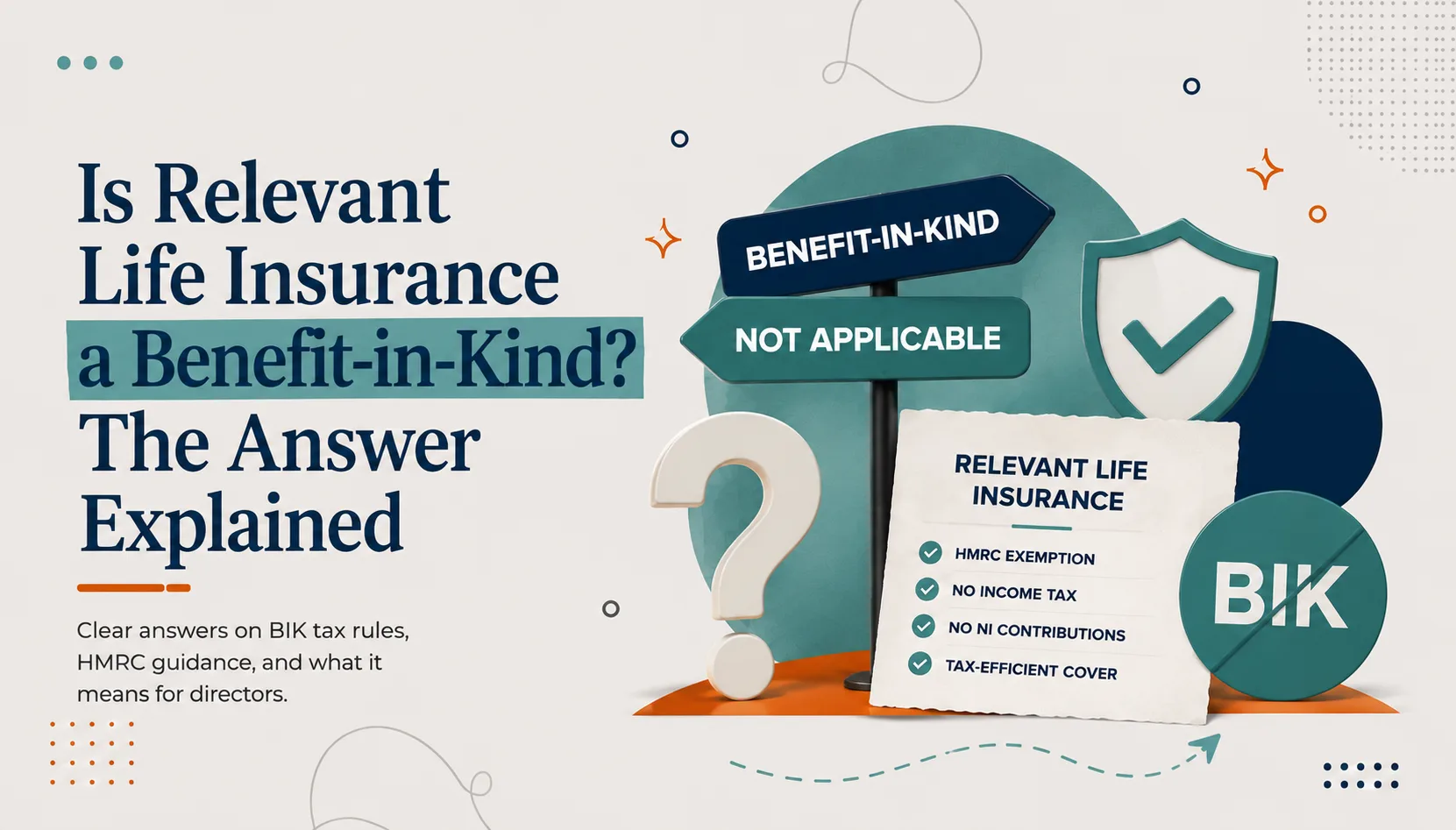

Most articles about relevant life insurance tell you that it qualifies for corporation tax relief and that HMRC doesn’t treat the premiums as a Benefit in Kind. What they rarely explain is why, and the reason is actually one of the most straightforward and compelling parts of the whole story.
Relevant life insurance exists because the government decided that smaller businesses should have access to the same tax-efficient life cover that large corporations have been offering their employees for decades. It’s a levelling-up exercise, and once you understand that, the tax treatment makes complete sense.
How large companies do it: death in service
If you work for a large employer, there’s a good chance you have death in service cover as part of your benefits package. It’s a lump sum, typically two to four times your salary, paid to your family if you die while employed. Most employees with this benefit have never had to arrange or pay for personal life insurance because their employer provides it as standard.
From a tax perspective, death in service works like this. The employer pays the premiums. Those premiums are treated as an allowable business expense: the company claims corporation tax relief on every pound it pays. And the employee pays no Benefit in Kind on the cover. No income tax, no National Insurance. The benefit is simply there, funded by the company, at a fraction of what it would cost the employee to arrange personally.
For large companies with hundreds or thousands of employees, this has been the standard approach for many years. It’s well understood, HMRC approved, and commercially very efficient.
The problem for smaller businesses
Until 2006, smaller businesses – director-owned limited companies, small professional practices, owner-managed firms – had no equivalent. Group life schemes require a minimum number of members to be viable, typically five or more. A two-director limited company couldn’t access a group scheme on competitive terms, which meant directors either paid for personal life insurance out of their own taxed income or went without.
The tax efficiency that a FTSE 100 employee took for granted as part of their standard benefits package simply wasn’t available to the director of a £2 million turnover business, not because of anything they’d done, but because the product didn’t exist yet.
The 2006 solution: relevant life insurance
In 2006 HMRC approved a new type of policy – relevant life insurance – specifically designed to extend the same tax treatment available to large company group life schemes to smaller businesses and individual directors.
The structure mirrors death in service exactly. The company pays the premiums. Those premiums are treated as an allowable business expense, qualifying for corporation tax relief. The director or employee covered by the policy pays no Benefit in Kind, no income tax, no employer’s National Insurance. And in the event of death, a tax-free lump sum is paid to the beneficiaries through a discretionary trust.
Same tax treatment. Same outcome for the family. Available to a single-director limited company in exactly the same way as it is to a business with five hundred employees.
That’s the levelling-up exercise the government intended and it’s why the tax treatment works the way it does. It’s not a loophole or a grey area. It’s a deliberately designed policy that HMRC has approved and that has been in use for nearly twenty years.
Well tested and HMRC approved
Relevant life insurance has been available since 2006, which means it has nearly two decades of established use behind it. Thousands of UK directors and businesses have used it. The tax treatment has been tested, challenged, and confirmed. The major insurers; Legal & General, Aviva, Zurich, LV= and others, all offer relevant life policies as standard products.
This isn’t a new or experimental arrangement. It’s a mature, well-understood product with a clear regulatory framework and a long track record. Directors who haven’t yet arranged relevant life cover aren’t missing a new opportunity, they’re missing something that has been available and HMRC approved for nearly twenty years.
The tax treatment in summary
To bring it together clearly:
Large company death in service: Employer pays premiums, claims corporation tax relief, employee pays no BIK, family receives tax-free payout.
Relevant life insurance: Company pays premiums, claims corporation tax relief, director pays no BIK, family receives tax-free payout via discretionary trust.The mechanism is the same. The tax treatment is the same. The only difference is the name of the product and the size of the business arranging it.
For any director currently paying for life insurance personally out of income that has already been taxed, the relevant question isn’t whether relevant life is legitimate. It is, unambiguously. The question is why they haven’t switched yet.
Our insights
Read our collection of insights and blogs to find out what other business owners and the industry is doing.