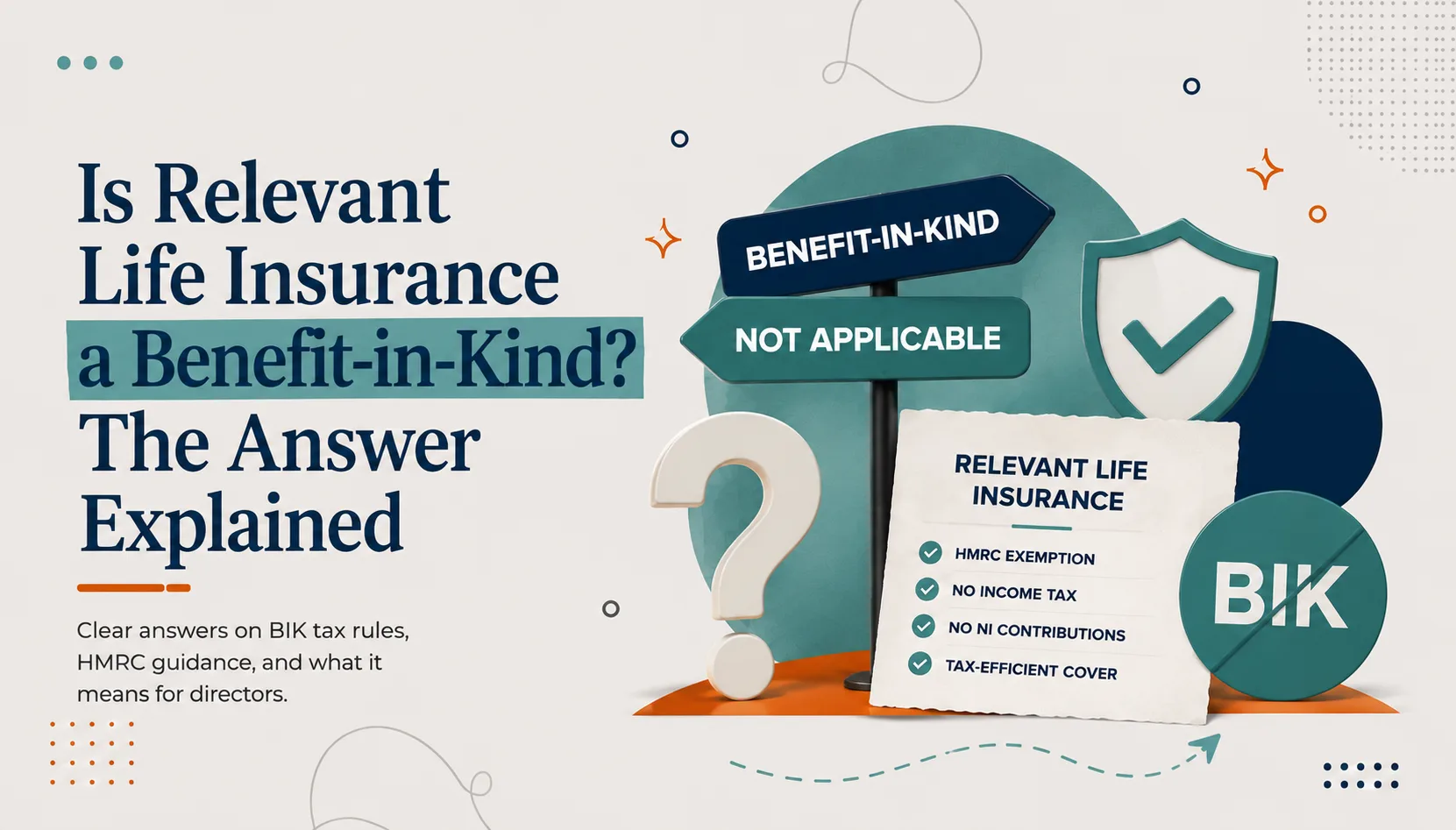
A Relevant Life Insurance policy is a highly tax-efficient way for limited company directors to secure personal coverage. Because premiums are paid by the business, they qualify as an HMRC-approved allowable expense (EIM15045), eligible for corporation tax relief of up to 25% (for profits over £250,000 in 2026/27).
This simple setup dramatically reduces your costs: a £100 monthly premium has a net cost to the company of just £75. To get the same level of cover via a personal policy, your business would need to generate £207.52 in gross income.
What Is Corporation Tax Relief?
Corporation tax is the tax UK limited companies pay on their annual profits. The rate in 2026/27 ranges from 19% to 25% depending on profitability. Full rate details are available on HMRC’s corporation tax rates page.
The principle behind corporation tax relief is straightforward: HMRC allows companies to deduct qualifying business expenses from their taxable profit before calculating the tax owed. Every pound spent on a qualifying expense reduces profit — and therefore reduces the corporation tax bill by the applicable rate. For a limited company director considering relevant life policy cover, this is a direct and quantifiable saving.
Source: gov.uk/corporation-tax-rates — 2026/27 rates.
Does Relevant Life Insurance Qualify for Corporation Tax Relief?
Yes. HMRC formally approves relevant life insurance as a qualifying employee benefit under EIM15045 — Employer-financed retirement benefit schemes: relevant life policies. Under HMRC EIM15045, the policy must be a life-only policy (not an investment bond), written under a relevant life trust from outset, with the benefit payable to the employee’s family or dependants.
When those conditions are met, relevant life insurance premiums are a legitimate business expense and qualify for corporation tax relief. This is what makes relevant life policy cover one of the most tax-efficient benefits available to a limited company director.
This means your company pays the premiums gross, claims the corporation tax relief, and the net cost is reduced accordingly. The director does not need to draw income from the company to fund the premium, which also avoids dividend tax entirely.
What Is the Net Cost of a Relevant Life Policy After Corporation Tax Relief?
Figures based on the 25% main rate of corporation tax, 2026/27. Source: gov.uk/corporation-tax-rates. For companies in the marginal relief band, the effective saving will be between £19 and £25 per £100 of premium.
How Does Relevant Life Insurance Corporation Tax Relief Compare to Paying Personally?
If a limited company director does not hold a relevant life policy and instead funds a personal life insurance policy, the premiums come from net income. To extract money from the company as a higher-rate taxpayer, that income first faces corporation tax (25%), then higher-rate dividend tax (35.75% in 2026/27). The cumulative tax burden is substantial. A director in this position requires £207.52 of gross company income to fund every £100 of personal premium. Under the relevant life route, the same £100 premium costs the company just £75 net, a gross income saving of £107.52 per month.
Last reviewed: June 2026. Next review: April 2027. Tax rates and thresholds are subject to change. This article will be updated following each HMRC Autumn Budget or Spring Statement where relevant thresholds change.
Our insights
Read our collection of insights and blogs to find out what other business owners and the industry is doing.